First Week Volunteer Teaching Program: Enhancing English and Mathematics Learning at Dharma Putra Swadaya
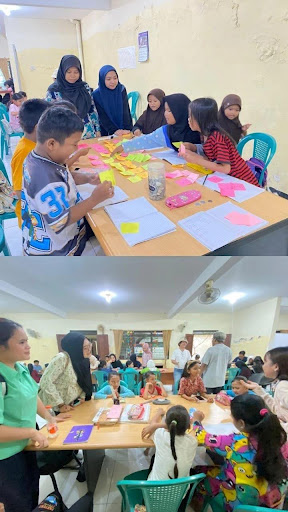
On Saturday, April 18, 2026, representatives of Batch 1 Group 24 from the Dharma Putra Swadaya (DPS) Unit conducted their first volunteer teaching activity as part of a community service program in the field of education. The activity took place from 3:00 PM to 4:00 PM and involved students from Grade 2, Grades 3–4, Grade 5, and Grade 6. The volunteers participating in this program were Emiliana Wati, Rehngenna Sitepu, Tagkang Minerva, Aisyah Putri Mahardika, Putri Okta Yogi Kristiani, Nisrina Mumtaza, and Firni Ramadhani.
The activity aimed to improve students’ understanding of English and Mathematics through engaging and accessible learning methods. It also provided university students with valuable opportunities to develop their teaching skills in a real educational setting. To ensure effective learning, the volunteers were divided into several groups based on the grade levels they taught.
In Grade 2, the volunteers introduced number words using sticky notes and folio paper as learning media. Students were encouraged to write numbers in word form and place them on sticky notes as part of the learning activity. This method successfully increased students’ participation and interest in the lesson. The activity was facilitated by Emiliana Wati, Rehngenna Sitepu, and Tagkang Minerva.
In Grade 6, students learned English vocabulary related to classroom objects. They were introduced to words such as table, chair, whiteboard, and stationery items. The lesson was conducted interactively by asking students to identify and point to objects around the classroom, making it easier for them to understand and remember the vocabulary. This class was facilitated by Aisyah Putri Mahardika and Putri Okta Yogi Kristiani.
Meanwhile, students in Grades 3 and 4 received lessons in both English and Mathematics. In the English session, they learned vocabulary related to daily activities, such as waking up, eating, studying, and playing. Students were also encouraged to create simple sentences using the vocabulary learned. In Mathematics, the volunteers taught multiplication using simple and gradual methods to help students understand the concepts more effectively. This class was facilitated by Nisrina Mumtaza and Firni Ramadhani.
In Grade 5, the volunteers taught Mathematics topics including addition, subtraction, and multiplication. Students were given practice exercises to strengthen their numeracy skills. In addition, they participated in an English picture-guessing game, where they identified classroom objects using English vocabulary. This activity created a fun and interactive learning atmosphere while reinforcing language skills.
Throughout the program, students showed high enthusiasm and active participation. They eagerly answered questions, engaged in classroom activities, and demonstrated strong interest in the learning methods used by the volunteers. The volunteers also worked hard to create an interactive and supportive learning environment so that students felt comfortable and motivated during the lessons.
Although several challenges emerged during the implementation, such as differences in students’ learning abilities, limited instructional time, and varying student characteristics across classes, the activities were conducted successfully. The volunteers addressed these challenges by applying flexible and adaptive teaching strategies. Students who quickly understood the material were provided with additional exercises, while those who required more assistance received individualized guidance through simpler explanations and closer support.
The volunteers also utilized attractive and interactive learning media to maintain students’ interest and engagement. The use of sticky notes, picture-guessing games, and hands-on learning activities effectively reduced boredom and encouraged active participation. These methods allowed students to learn not only through theory but also through direct involvement in the learning process.
Through this experience, the volunteers gained valuable insights into the realities of classroom teaching, which often differ from theoretical concepts learned at university. They learned how to manage diverse student characteristics, handle classroom dynamics, and make effective decisions in various teaching situations. The program also enhanced their communication skills, creativity in lesson planning, and classroom management abilities.
Overall, the first week of the volunteer teaching program was conducted successfully and achieved its intended objectives. The activity provided meaningful learning experiences for students while helping the university volunteers develop essential professional competencies as future educators. It is hoped that similar activities will continue to support students’ academic development and inspire future educational initiatives within the community.
