First Learning Assistance Session at Sanggar Merah Merdeka Tales: Developing Early Numeracy Skills Through Play-Based Learning
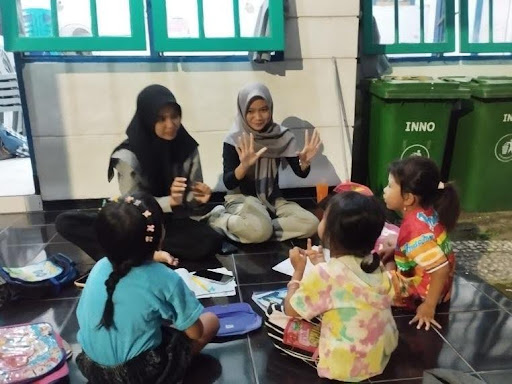
On Monday, April 13, 2026, students from the Early Childhood Teacher Education Program (PG-PAUD) at Universitas Negeri Surabaya (UNESA), namely Nabila Nur Roihanah (25010684161), Aindi Salwa Zaharani (25010684158), Dinda Amira Naura Putri (25010684114), and Risma Rahma Alifa (25010684157), conducted a learning and mentoring activity for young children at Sanggar Merah Merdeka Tales. This field practice activity was designed to develop the students’ teaching skills, communication abilities, and understanding of children's developmental characteristics through direct interaction in a non-formal educational setting.
The volunteer program involved 13 children from different educational levels, including Early Childhood Education (PAUD) and Kindergarten A. The activities were conducted regularly each week, with learning materials adjusted to the children’s developmental needs. Topics included number recognition, counting, reading, writing, and various motor and social development activities.
The first meeting took place from 6:30 PM to 7:30 PM and was conducted smoothly and in an orderly manner. The primary objective of this session was to provide practical teaching experience for the university students while supporting the cognitive development of young learners through engaging educational activities.
The learning session was held in the Akar Tales class and focused on introducing numbers from 1 to 10 and practicing simple addition. Several tutors worked collaboratively to guide and support the children throughout the learning process. These topics were selected because number recognition and basic counting skills are fundamental components of early childhood cognitive development and should be introduced gradually from an early age.
To create an enjoyable learning atmosphere, the tutors implemented a play-based learning approach. The children participated in various activities, including identifying numbers, counting aloud together, guessing numbers, counting simple objects, and solving basic addition exercises using attractive and child-friendly learning materials. The tutors also provided number-writing exercises to help children recognize number symbols while strengthening their fine motor skills.
Throughout the session, the children demonstrated enthusiasm and active participation. Most of them were already able to recognize numbers from 1 to 10 and recite them in the correct sequence. Many children also began to understand the concept of simple addition, although some still required additional guidance and practice. The tutors provided individualized assistance to ensure that each child remained confident and motivated while learning.
During the number-recognition activity, the tutors first introduced the shape of each number and then asked the children to identify and name the numbers shown. The children were subsequently encouraged to count simple objects around the classroom, helping them understand the relationship between numbers and quantities through direct experience. This interactive approach made the learning process more meaningful and easier for the children to understand.
The session continued with simple addition exercises using pictures and classroom objects as learning media. The children were asked to count and combine groups of objects while gradually learning the concept of addition. While some children demonstrated a good understanding of the activity, others still required repeated practice and reinforcement, which will continue in future sessions.
The children also participated in number-writing exercises using worksheets prepared by the tutors. This activity aimed to improve hand-eye coordination while helping the children become more familiar with the shapes of numbers. Some participants were able to write numbers accurately and neatly, while others experienced difficulties with certain number formations. The tutors patiently provided demonstrations and step-by-step guidance to support their learning.
Based on observations throughout the session, it was evident that each child possessed unique learning abilities and developmental characteristics. Some children were able to understand the material quickly and follow instructions independently, while others required more support in maintaining concentration and completing tasks correctly. Despite these differences, all participants demonstrated positive learning attitudes and remained engaged until the end of the activity.
Overall, the children showed promising progress in recognizing numbers from 1 to 10 and understanding basic addition concepts. Although some participants still needed additional practice in writing numbers and solving counting exercises, the foundation for further learning had been successfully established.
This activity also provided valuable practical experience for the PG-PAUD students. Through direct interaction with the children, they gained a deeper understanding of individual learning styles, attention spans, communication patterns, and developmental needs. Such experiences are essential in preparing future educators to become creative, patient, and adaptive teachers who can design learning experiences that meet the needs of young learners.
The play-based learning approach proved highly effective in increasing the children's enthusiasm and participation. The use of pictures, simple games, and direct interaction made the lessons more engaging and enjoyable. The relaxed yet structured learning environment allowed the children to absorb the material more effectively while fostering positive attitudes toward learning from an early age.
