Elementary Students’ Enthusiasm Increases as PG PAUD UNESA Students Conduct Learning Assistance at Sanggar Merah Merdeka
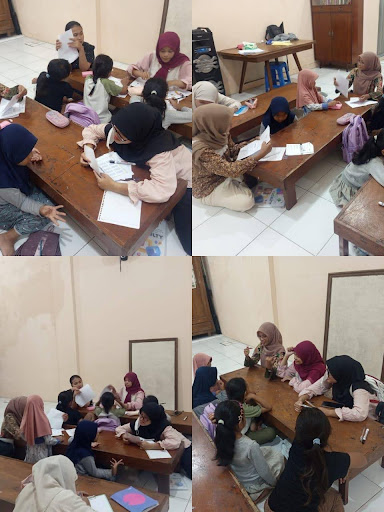
Surabaya – A learning assistance program conducted by university students at Sanggar Merah Merdeka, located at Lebak Arum Barat No. 21, Surabaya, successfully created an active, interactive, and enjoyable learning atmosphere for elementary school students. The program was carried out on Wednesday, April 15th, 2026, from 6:00 PM until completion, involving students from Grades 1 to 4 elementary school who were divided into two groups: Tunas Class and Melati Class. The main focus of the activity was to improve students’ basic mathematics skills, which are often considered difficult by some learners.
The activity was conducted by four university students, namely Nanda and Rara, who taught in Tunas Class (Grades 1–2), as well as Shilfi and Ais, who taught in Melati Class (Grades 3–4). During the implementation, the university students not only acted as teachers but also as learning companions who provided direct attention to each student according to their abilities and learning needs.
The lessons were carried out in several sessions in a simple classroom environment within the learning center area. Although the available facilities were relatively limited, this did not reduce the students’ enthusiasm for learning. The children appeared to sit in groups around wooden tables while working on worksheets, discussing with friends, and occasionally asking questions to the university student facilitators. The learning atmosphere appeared relaxed yet conducive, allowing students to participate comfortably and without pressure.
In Tunas Class, Nanda and Rara began the activities by teaching memorization of basic multiplication and division. The method used involved oral repetition together, followed by students individually reciting their memorization in front of the facilitators. This approach proved effective in training memory skills while also increasing students’ self-confidence. Several students who were initially hesitant gradually became more confident in answering aloud after receiving motivation and appreciation.
After the memorization session, the lesson continued with addition and subtraction involving money values. The students were given simple examples related to everyday life, such as calculating total shopping expenses at a small shop or determining the remaining money after buying snacks. This contextual approach made it easier for students to understand mathematical concepts because they could directly connect the lessons to their daily experiences. Furthermore, this method also helped students develop logical thinking and basic problem-solving skills.
As a form of evaluation, Nanda and Rara provided additional exercises to the students. During the activity, they actively moved around the classroom to assist students who experienced difficulties. The interaction demonstrated that students were not hesitant to ask questions and attempt to solve problems independently. Some students even helped their classmates, creating a collaborative learning atmosphere.
Meanwhile, in Melati Class, Shilfi and Ais also began the lesson by reinforcing multiplication and division memorization at a higher level of difficulty. Students were asked to recite their memorization directly as an initial evaluation to determine the extent of their understanding of basic concepts. Through this activity, the university students were able to identify learners who required more intensive guidance.
The lesson then continued with basic formulas for plane geometry. Shilfi and Ais explained the concepts of area and perimeter for shapes such as squares, rectangles, and triangles in a simple and easy-to-understand manner. The explanation was accompanied by concrete examples, such as drawing geometric shapes on the whiteboard and inviting students to calculate together, allowing students to understand the material gradually.
To deepen understanding, students were given exercises related to calculating the area and perimeter of plane figures. During this process, students actively discussed the problems with their classmates. Shilfi and Ais also provided direct guidance to students who still experienced difficulties, making the learning process more effective. In addition, the university students gave immediate feedback on students’ answers so they could recognize mistakes and improve them.
This learning assistance activity was implemented as a tangible contribution from university students in helping learners overcome learning difficulties, particularly in mathematics. Furthermore, the activity also aimed to increase students’ interest in learning through more interactive, communicative, and enjoyable teaching methods. Through a non-rigid approach, students became more relaxed and did not feel burdened during the learning process.
Through communicative and participatory approaches, the university students successfully created a more lively classroom atmosphere. This could be seen from the students’ enthusiasm when reciting memorization and completing practice questions. They appeared more confident, active in asking questions, and brave in expressing answers in front of their classmates. Even some previously passive students began to show progress in terms of confidence and participation.
Overall, the activities conducted at Sanggar Merah Merdeka ran smoothly and had a positive impact on the students. Their basic mathematics abilities began to improve, especially in understanding concepts, accuracy in calculations, and self-confidence. In addition, the activities also helped build positive learning habits from an early age.
On the other hand, this activity also provided valuable experience for the university students in developing teaching skills, communication abilities, and strategies for handling students with diverse characteristics. The university students learned to become more patient, creative, and adaptive in delivering material so that it could be well understood by the learners.
Through programs like this, it is hoped that learning activities outside formal schools can continue and provide broader benefits to the community. Sanggar Merah Merdeka is expected to continue serving as an inclusive and child-friendly learning space that supports both the academic and character development of children.
In the future, this learning assistance program is expected to be implemented continuously with a broader range of subjects, not only mathematics but also other lessons. In this way, more students can be supported in improving the quality of their learning and gaining strong motivation to achieve success in the future.
