Community Service Activity: Interactive Numeracy Learning and Educational Games at Novaloka Institute
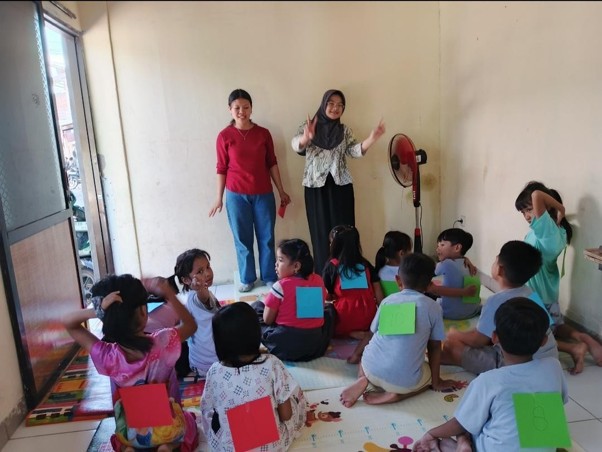
On Friday, May 15, 2026, a community service activity was successfully conducted at Novaloka Institute, located at Jalan Pakis Gunung I No. 133, Pakis Village, Sawahan District, Surabaya City. The learning environment was calm, clean, and conducive, creating an ideal atmosphere for both students and facilitators. This program was organized as part of the university students’ commitment to applying their knowledge in the community, particularly in the field of basic education. The primary objectives of the activity were to strengthen children’s numeracy skills, introduce number concepts and basic arithmetic operations, and provide practical teaching experience for the student facilitators.
The activity began with an opening session consisting of a joint prayer, self-introductions, and an ice-breaking activity. The prayer was conducted as an expression of gratitude and a hope for the smooth implementation of the program. Following this, the facilitators introduced themselves and invited each child to share their name. This session helped build familiarity, confidence, and a positive relationship between the facilitators and participants. To create a more engaging learning environment, the children then participated in educational songs accompanied by simple body movements. This activity successfully reduced feelings of shyness and encouraged active participation.
The first core learning activity focused on introducing numbers from 1 to 20. The facilitators taught the children how to recognize number symbols, pronounce number names correctly, and understand their sequential order. Large and clear visual representations of numbers were displayed on the board, while real-life objects such as seeds, matchsticks, and pictures were used as teaching aids to help children understand the connection between numbers and quantities. The children enthusiastically practiced identifying and naming numbers both individually and as a group.
The second activity involved completing missing numbers in a sequence. The facilitators wrote number sequences on the board with one or two numbers intentionally omitted. The children were asked to identify and fill in the missing numbers correctly. This exercise strengthened their understanding of number order, memory skills, concentration, and attention to detail. The activity encouraged active participation, with many children eagerly volunteering their answers and supporting one another during the learning process.
The third activity focused on solving simple addition and subtraction problems. Using concrete objects and practical demonstrations, the facilitators explained the basic concepts of combining and subtracting quantities. The children were then given worksheets containing arithmetic exercises involving numbers from 1 to 20. Throughout the activity, the facilitators provided guidance and support, helping the children understand each step of the calculation process. Most participants completed the exercises successfully and demonstrated a growing understanding of basic mathematical operations.
To reinforce the concepts learned throughout the session, an educational game called “The Missing Number Train” was conducted. In this activity, children worked in small groups to complete a train made of numbered carriages. Some carriages were intentionally left blank, and the children had to find and place the correct numbers in the appropriate positions to complete the sequence. The game was highly engaging and encouraged teamwork, cooperation, problem-solving, and communication among participants. The children enjoyed the activity immensely, as it combined learning with play in a fun and meaningful way.
At the end of the program, all participants gathered for a closing session. The facilitators expressed their appreciation for the children’s enthusiasm, cooperation, and active involvement throughout the day. The children were encouraged to continue practicing their counting skills at home and to maintain a positive attitude toward learning.
The activity concluded with a closing prayer, followed by a group photo session to capture the memorable moments shared by the participants and facilitators. The cheerful smiles and enthusiasm displayed throughout the event reflected the success of the program and the positive impact it had on the children.
This report is prepared as an official record of the community service activity and its successful implementation. It is hoped that the program contributed positively to the development of the children’s numeracy skills and fostered a greater interest in learning through interactive and enjoyable educational experiences.
