Training on Implementing a Deep Learning Approach to Stimulate Critical Thinking Skills in Early Childhood
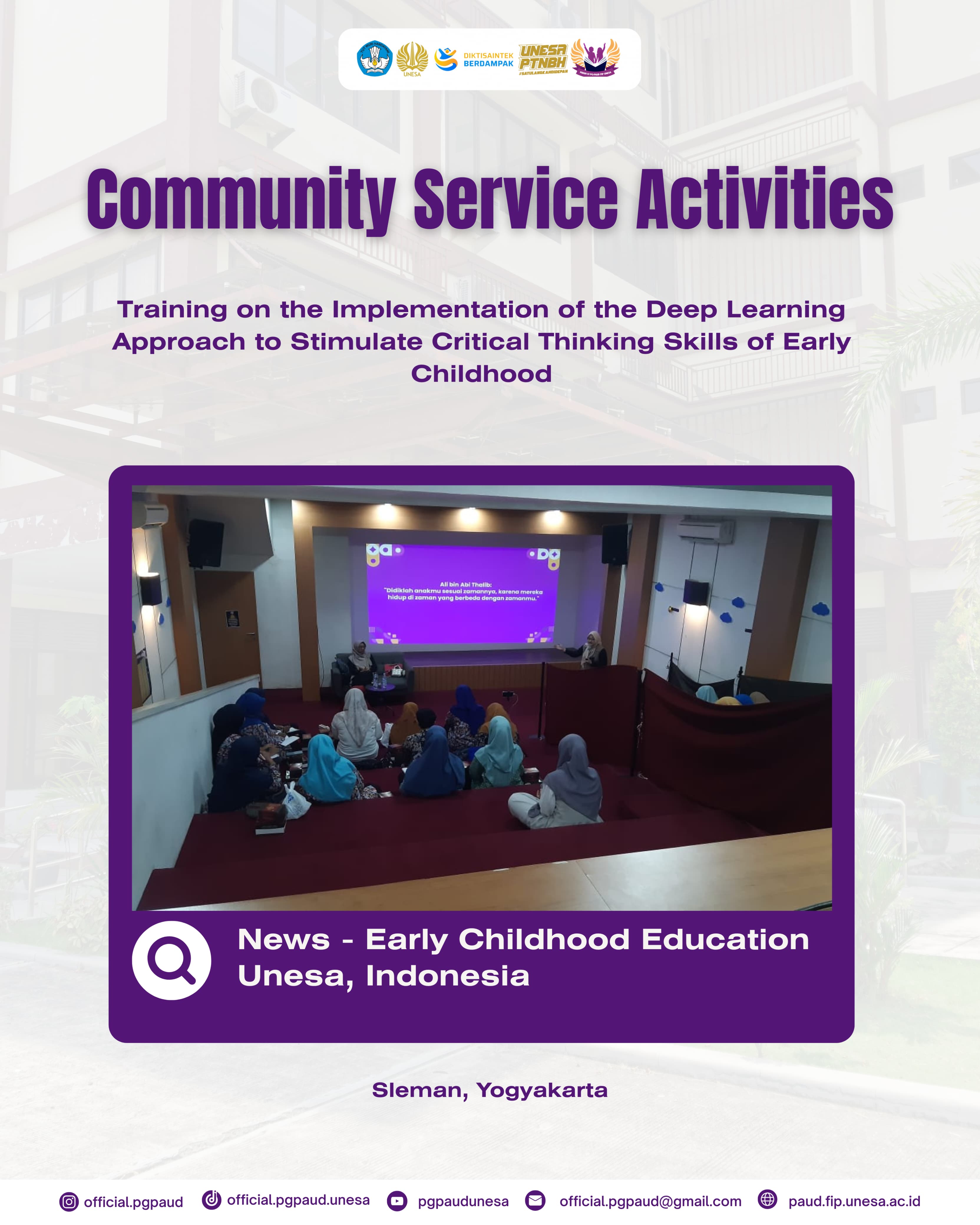
The Early Childhood Teacher Education Study Program (ECE) at Universitas Negeri Surabaya (UNESA) has conducted a Community Engagement (PkM) activity titled "Training on Implementing the Deep Learning Approach to Stimulate Critical Thinking Skills in Early Childhood." This activity took place in Sleman Regency, Yogyakarta, aiming to enhance the capacity of early childhood education (PAUD) teachers in designing learning that encourages children to think critically, reflectively, and logically through a deep learning approach. Teachers participating in the training were provided with insights and hands-on practice to develop more profound and meaningful learning experiences for young children.
The training featured two main speakers, Afifah Rahmaningrum, M.Pd., and Dewi Komalasari, M.Pd., who provided intensive guidance on applying deep learning teaching strategies within the PAUD context. In her presentation, Afifah stated, "Deep learning allows children to build understanding through active exploration, observation, and discussion." Dewi added, "Early childhood children are actually capable of critical thinking if we give them space to ask questions, guess, and conclude." The training included simulations of deep learning-based Daily Lesson Plans (RPPH) that were applicable and appropriate for child development.
This activity was part of a PkM program chaired by Afifah Rahmaningrum, M.Pd., with team members: Dewi Komalasari, M.Pd., Nur Ika Sari Rakhmawati, M.Pd., Muhammad Reza, M.Si., and Dr. Dwi Jayanti Kurnia Dewi, M.Pd. Participants responded positively to the training. One teacher stated, "We are now more courageous in changing our teaching patterns to be more exploratory and involve children in thinking, not just memorizing." This activity is part of PG-PAUD UNESA's efforts to support 21st-century learning practices in early childhood education, emphasizing reflective and participatory thinking from an early age.
