Optimizing Early Childhood Education Teacher Competence Through Diagnostic Assessment for Excellent Early Childhood Education.
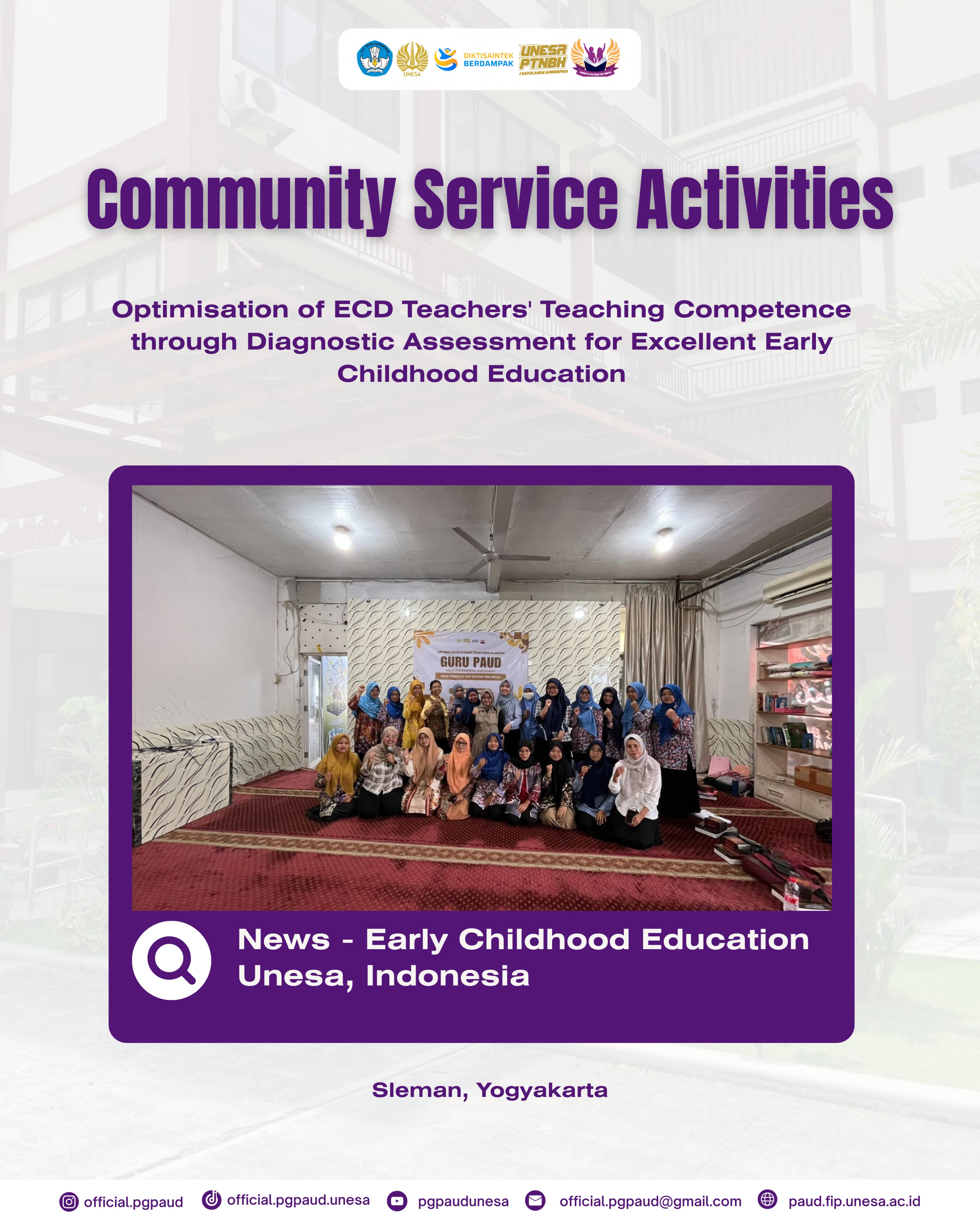
The Early Childhood Teacher Education Study Program (ECE) at Universitas Negeri Surabaya (UNESA) recently conducted a Community Engagement (PkM) activity themed, "Optimizing Early Childhood Education Teacher Competence Through Diagnostic Assessment for Excellent Early Childhood Education" in Yogyakarta. This activity was designed to enhance teachers' abilities in conducting diagnostic assessments as an initial step to design learning that aligns with each child's developmental needs. Through this training, PAUD teachers are expected to be able to perform an early, structured identification of students' individual potentials, challenges, and needs.
As the main speaker, Dhian Gowinda Luh Safitri, M.Ed., presented material on the concept and practice of diagnostic assessment within the context of early childhood education. During the training session, Dhian emphasized, "Diagnostic assessment is not just about evaluating, but about observing, recording, and understanding children comprehensively to provide appropriate learning responses." Training participants were also equipped with examples of simple instruments, methods for analyzing assessment results, and developing responsive follow-up learning plans tailored to children's characteristics.
This activity was chaired by Dr. Kartika Rinakit Adhe, M.Pd., with team members: Dhian Gowinda Luh Safitri, M.Ed., Dr. Yes Matheos L Malaikosa, M.Pd., and Melia Dwi Widayanti, M.Pd. The PAUD teachers who participated in the training expressed their enthusiasm for this approach. One participant stated, "We now better understand how to identify children's needs early on and design learning that isn't uniform but is precisely targeted." This activity is part of PG-PAUD UNESA's commitment to fostering adaptive, data-driven, and holistic child development-oriented early childhood education quality.
