Interactive Mathematics Learning and Creative Thumbprint Memory Activity at Sanggar Merah Merdeka Unit Lebak
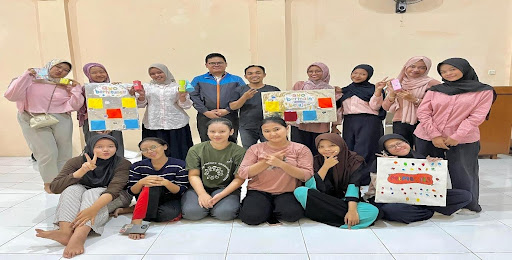
On Wednesday, April 29, 2026, a learning activity was conducted at Sanggar Merah Merdeka Unit Lebak. The activity ran smoothly and was attended by children from various educational levels, including Bibit (Early Childhood Education), Akar (Kindergarten), Tunas (Grades 1–2), Melati (Grades 3–4), and Dahlia (Grades 5–6). The program was facilitated by youth volunteers from Sanggar Merah Merdeka and students from the Early Childhood Education Teacher Education Program (PG-PAUD) at Universitas Negeri Surabaya (UNESA): Alif Miftakhul Jannah (25010684200), Firda Ayu Amanda (25010684134), Chevilla Azra Ayuningtyas (25010684014), and Irma Ayu Nur Affirda (25010684016).
The learning activities were tailored to the age and abilities of each class. In the Bibit class, children practiced counting through a game using a pocket counting board. They counted the number of pictures displayed, selected the corresponding number, and placed it into the appropriate pocket. This activity was designed to develop basic numeracy skills while improving children's accuracy and concentration.
In the Akar class, the children practiced addition and subtraction using a counting board. Through this hands-on learning activity, they were encouraged to learn mathematics in a fun and engaging way, making it easier for them to understand basic mathematical concepts.
For the Tunas and Melati classes, the session began with multiplication memorization, as is customary. Afterward, the children participated in a learning game using multiplication domino cards created by the UNESA students. This activity aimed to strengthen multiplication skills while increasing children's enthusiasm for learning through an enjoyable and interactive method.
Meanwhile, in the Dahlia class, the children first recited their multiplication facts to the teachers. They then learned about three-dimensional geometric shapes by assembling simple models made from creatively designed buffalo paper. After constructing the shapes, the children were guided to calculate their volumes. This activity was intended to enhance their understanding of geometry while also developing their motor skills and creativity.
Throughout the learning session, the atmosphere was active, engaging, and enjoyable. The children participated enthusiastically in every activity, while the facilitators continuously provided guidance, support, and encouragement.
It is hoped that through these activities, the children will improve their numeracy skills, gain a deeper understanding of mathematical concepts, and develop a greater enthusiasm for learning through interactive and enjoyable educational methods.
As a final activity, the UNESA students initiated a special memory-making project for the children. Each child created a thumbprint artwork on a canvas using acrylic paint. This activity generated great excitement among the participants, as it allowed them to explore and recognize different colors, practice patience by waiting for their turn, and contribute to a meaningful collective artwork. The thumbprint canvas became a memorable keepsake that reflected the children's participation and creativity throughout the program.
This report is hereby prepared as documentation of the activities that have been successfully carried out.
