Exploring Science and Art Through Leaves: Texture Discovery, Leaf Veins, and Leaf Printing Activities
THIRD MEETING – Science and Art Exploration (Leaf Textures, Leaf Veins, and Leaf Printing)
Day/Date: Sunday, May 24, 2026
Time: 3:30 PM – 4:35 PM WIB
Location: Pijar Tambak Mayor, Surabaya
Activity: Pijar Volunteer Batch 2 Group 39
The third meeting marked the final session of the regular volunteer program. The activity began with a joint prayer, followed by dividing the children into two groups as usual. By this point, the children had become very familiar with the activity routine, allowing the session to begin smoothly without requiring much preparation or classroom management. They immediately sat with their respective groups, eager and enthusiastic to participate.
The younger group (Egg and Caterpillar classes) learned about three different leaf textures: rough (cassava leaf), hairy (guava leaf), and smooth (aloe vera leaf). Each child was given the opportunity to touch real leaves while blindfolded and guess their texture. The activity created a joyful atmosphere, especially when some children guessed incorrectly and everyone laughed together. Afterward, the children sang a modified version of the song “My Five Balloons” with lyrics adapted to describe the different leaf textures. They enjoyed the song so much that they asked to sing it several times and eventually memorized it with enthusiasm.
Meanwhile, the older group (Cocoon and Butterfly classes) studied three types of leaf venation: parallel veins (found in rice, corn, and bamboo leaves), palmate veins (found in papaya and cassava leaves), and pinnate veins (found in guava and mango leaves). The children observed real leaf samples and classified them according to their vein patterns. A brief discussion followed about which types of leaves would be most suitable for printing activities, leading them to conclude that leaves with clearly visible veins produced the best prints.
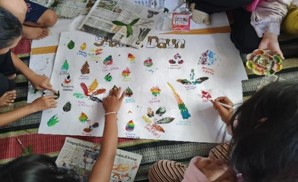
After completing their group activities, all children gathered in a large circle for a creative leaf-printing session. Each child selected a favorite leaf, applied colorful paint to the underside of the leaf, and pressed it onto paper to reveal the unique vein patterns. The children were delighted to see the beautiful prints emerge. Their finished artworks were then collected and displayed on a large poster board as a keepsake for Pijar. The children also wrote their names and personal reflections about the activities they had experienced throughout the program. To preserve the artwork, the display was covered with a transparent plastic sheet.
The advocacy message delivered during this meeting continued to emphasize fairness and equality but focused more specifically on appreciating one’s own work and respecting the work of others. Volunteers explained that every child has the right to feel proud of their creations, regardless of whether the results are neat or imperfect. What matters most is the effort invested in the process. The children were also reminded not to criticize or belittle their friends’ work because every person has unique strengths and talents.
The session concluded with a short reflection activity in which the children shared what they had learned throughout the day. Volunteers further explained additional applications of leaves in art projects and discussed different types of paint that could be used for leaf printing. The program then ended with a closing prayer and a group photo session. Smiles filled the room as both the children and volunteers proudly held up their leaf-print artworks.
Although this third meeting marked the conclusion of the regular volunteer program, it was not the end of our commitment to the children at Pijar. Through the leaf-printing activity, the children learned that their creations—no matter how simple—deserve appreciation and recognition. They discovered that every piece of artwork carries its own value and uniqueness, making comparisons unnecessary. This advocacy message on fairness and equality was conveyed through the appreciation of children's efforts and creativity. The children went home carrying not only their memories but also a sense of pride, knowing that their work had been displayed on a large board for everyone to see. This simple gesture served as a meaningful form of psychological support and encouragement for each child.
