Enhancing Early Numeracy and Body Awareness Through Interactive Learning at Sanggar Merah Merdeka Tales
berita terkait
- PG PAUD UNESA Dukung Kilau Mania HAN 2026 melalui Volunteering Advokasi Hak Anak
- S1 PG-PAUD UNESA Supports Human Resource Development Through Collaboration with the Madiun Regency Education Office
- S1 PG-PAUD UNESA Collaborates with the Directorate of Early Childhood Education to Support the 2025 PAUD Revitalization Program
- S1 PG-PAUD UNESA Strengthens Research Collaboration with the Department of Education, Youth, and Sports of Temanggung Regency
- PG-PAUD UNESA Expands Research Collaboration with CV Wardhana Through Merdeka Belajar Internship Program
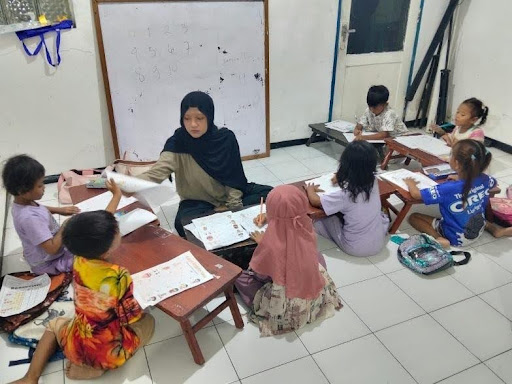
On Monday, April 20, 2026, our group consisting of Nabila Nur Roihanah (25010684161), Aindi Salwa Zaharani (25010684158), Dinda Amira Naura Putri (25010684114), and Risma Rahma Alifa (25010684157) conducted a learning assistance program with children at Sanggar Merah Merdeka Tales. The activity took place from 6:30 PM to 7:30 PM and was carried out smoothly and in an orderly manner. This program was part of the field practice activities of students from the Early Childhood Teacher Education Program (PG-PAUD) at Universitas Negeri Surabaya (UNESA), aimed at developing teaching skills and gaining direct experience in supporting early childhood learning.
The participants came from several classes, including Akar PAUD, Akar TK A, Akar A Tales, and Akar B Tales. The learning materials focused on number recognition, basic counting exercises, number writing, and understanding the functions of body parts. Throughout the session, the tutors implemented a play-based learning approach to create a comfortable and engaging learning environment. Various learning media such as pictures, worksheets, educational games, and interactive activities were used to enhance children’s focus, participation, and enthusiasm.
In the Akar TK A class, learning activities focused on number-writing practice and the introduction of basic counting concepts. The children were guided to recognize number symbols and then independently practice writing them on worksheets. Afterward, they were asked to count objects shown in pictures as well as items found around them. These activities were designed to support cognitive development, improve concentration, and strengthen fine motor skills through writing and counting exercises.
In addition to learning numbers, the children were introduced to different body parts and their basic functions in daily life. The tutors explained body parts such as the eyes, ears, hands, feet, and nose through question-and-answer sessions and direct interaction. The children actively participated by naming body parts and explaining their functions, demonstrating enthusiasm and curiosity throughout the activity.
In the Akar PAUD class, the session began with a group prayer before learning activities started. The tutors then reviewed the previous lesson on numbers 1 to 5 to reinforce the children’s understanding. The children enthusiastically participated in both group and individual number-recognition activities.
The lesson continued with the introduction of numbers 6 to 10 through a learning-through-play approach. The tutors used picture cards featuring cakes of various quantities and colors. The children were asked to circle the pictures that matched the numbers mentioned by the tutors. This interactive method made the learning experience enjoyable and encouraged active participation from the children.
At the end of the session, the children took part in movement-based games, including forming small and large circles and participating in a train-themed group activity. These games were designed to develop gross motor skills, teamwork, confidence, and social interaction. The children greatly enjoyed the activities and participated enthusiastically until the session concluded. The learning activities were then closed with a prayer before the children returned home.
In the Akar A Tales class, two tutors guided four students through activities focused on number recognition and basic counting skills. The children completed worksheets, counted objects shown in pictures, and practiced writing number symbols. Most of the participants demonstrated a good understanding of number concepts. Some children were able to complete tasks independently and follow instructions quickly, while others still required additional guidance to maintain focus during learning activities.
Meanwhile, in the Akar B Tales class, two tutors worked with seven students. The learning materials included counting, number writing, and identifying the functions of body parts. Overall, the children showed a positive understanding of the concepts presented and were able to participate effectively in the learning process. However, several children still needed further assistance and encouragement, as their attention could easily be diverted during activities.
Based on the implementation of this learning session, the play-based learning method proved effective in increasing children’s enthusiasm and engagement. The children became more active, confident, and willing to participate when lessons were delivered through interactive and enjoyable activities. Besides supporting children’s cognitive and social development, this experience also provided valuable practical learning opportunities for PG-PAUD students in understanding the diverse learning characteristics and developmental needs of young children through direct observation and interaction.
