Strengthening Literacy and English Language Skills Through Interactive Learning at Sanggar Merah Merdeka
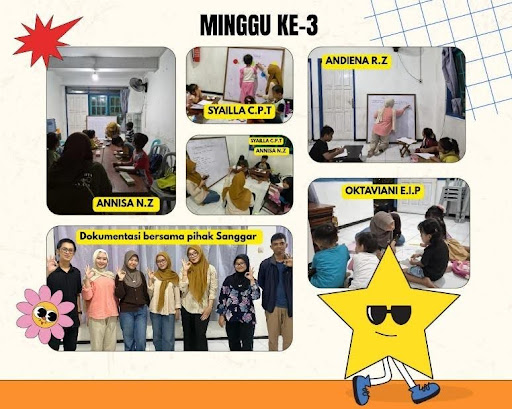
During the final week of the community service program, held on April 28, 2026, Group 3 conducted a series of educational activities for children in several early childhood learning classes at Sanggar Merah Merdeka. The learning sessions were facilitated by students from the Early Childhood Education Program (PG PAUD) of Universitas Negeri Surabaya (UNESA) together with youth volunteers from the learning center, including Annisa, Syailla, Oktaviani, Andien, Yasmin, and Kasih.
In Akar Class, attended by Aura, Yasmin, Asma, and Rizki, the learning activities were conducted in a dynamic and engaging manner. The lessons focused on recognizing the alphabet letters A to H, practicing letter writing, and singing the song “Pelangi” (Rainbow) to create a fun and enjoyable learning atmosphere. While several children were able to follow the lessons well, some still required additional support and guidance to fully participate in the activities.
In Akar A Class, five students—Adnan, Zia, Bilqis, Ulfi, and Safira—learned about vowel letters (a, i, u, e, o) through a hands-on matching and pasting activity. Before beginning the main lesson, the students reviewed the alphabet from A to Z. In general, they were able to recite the letters in sequence, although many still experienced difficulty recognizing letters when presented in a random order.
Meanwhile, Tunas B Class focused on learning lowercase letters and matching uppercase letters with their lowercase forms. Nine students participated enthusiastically in the session. Most of them demonstrated basic reading skills; however, some still struggled with identifying letters toward the end of the alphabet, such as V, W, X, Y, and Z. Overall, the students showed good progress, although several still required additional practice.
In Tunas Tales Class (Grades 1–2 Elementary School), Azril, Adiba, and Arsya studied action verbs through explanations, writing exercises, student worksheets (LKPD), and a word-guessing game. Azril showed a good understanding of the concept, although he still encountered challenges when applying it in different contexts. The students generally demonstrated a satisfactory level of understanding but would benefit from further reinforcement and continued learning.
In Melati Class, Nara and Rafli participated in an English vocabulary lesson focusing on parts of the body. The lesson was delivered interactively through a question-and-answer method. Rafli demonstrated strong English language skills and was able to respond confidently, while Nara showed enthusiasm but still needed additional practice to strengthen her understanding.
Finally, in Dahlia Class, Rafa, Alfa, and Arum learned about the concept of comparison in English. The lesson included explanations, practical exercises, and worksheet activities. While the students generally achieved positive learning outcomes, some still experienced confusion regarding the correct use of comparative forms and concepts.
Overall, the final week of the community service program was successfully implemented and provided meaningful learning experiences for the children. The activities helped strengthen literacy, language, and communication skills while encouraging active participation and confidence. The program also offered valuable teaching experience for the facilitators in supporting children's learning and development through engaging and interactive educational activities.
