VOLUNTEER PROGRAM AT PELITA INSAN PEMBELAJAR (PIJAR) SIMOKERTO UNIT Batch 1 Group 9
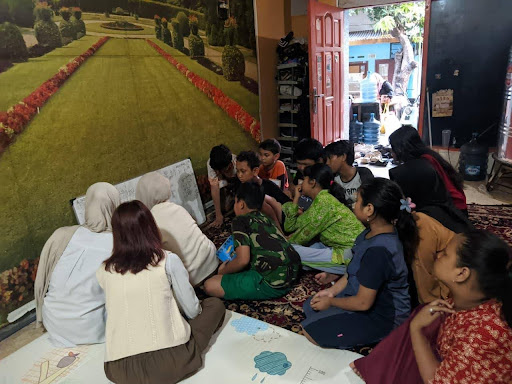
As a form of community service implementation as well as strengthening competencies as prospective educators, a group of undergraduate students from the Early Childhood Teacher Education Study Program (PGPAUD), namely Anggun Putri Surya (25010684042), Mazya Alfi Sabrina Aulia (25010684044), Zhaskia Mauliddya Subiantoro (25010684045), and Rehanun Aisyah Prasetyo (25010684223), carried out a volunteer teaching program at Lembaga Pijar (Pelita Insan Belajar). This institution is located in Simokerto District, specifically in the Tambak Madu area, Surabaya. The volunteer activity was conducted over a period of three weeks, with sessions held every Friday from 3:30 PM to 5:00 PM.
This volunteer program involved 11 children from various educational levels, including students from grades 4, 5, and 6 of elementary school as well as grades 7, 8, and 9 of junior high school. The diversity of educational backgrounds presented its own challenges for the facilitators, considering the differences in comprehension levels, learning needs, and developmental characteristics among the participants. However, this situation also became a valuable opportunity for the volunteers to develop their adaptability in teaching students of different ages.
During the first meeting, the learning activities focused on two main aspects: improving academic abilities through mathematics exercises and developing communication skills through simple presentation activities. The session began with the distribution of mathematics questions that had been adjusted according to each student’s grade level. The children were given time to work on the questions independently, allowing them to practice critical thinking and problem-solving skills individually.
After all participants completed the exercises, the activity continued with a discussion session. During this session, the facilitators guided the children in understanding the correct methods of solving the problems while also giving them opportunities to ask questions whenever they encountered difficulties. This approach not only helped improve their understanding of mathematical concepts but also encouraged the children to become more active in the learning process.
The activity then proceeded with a presentation session aimed at building confidence in public speaking and improving verbal expression skills. In this session, each child was asked to bring an object commonly found in daily life, such as a comb, glasses, a toy car, a spoon, or a fork. They were then encouraged to share a personal experience related to the object they had brought.
The session took place in an interactive and enjoyable atmosphere. The children appeared enthusiastic while sharing their stories, although some of them initially seemed shy. With encouragement and support from the facilitators, they gradually became more confident in speaking in front of their peers. This demonstrated that learning approaches involving personal experiences can be an effective method for improving children’s communication skills.
The implementation of this activity also demonstrated that PGPAUD students possess the ability to adapt their teaching skills not only for early childhood education but also for higher educational levels such as elementary and junior high school students. This serves as evidence that fundamental competencies in education, including communication skills, understanding students’ characteristics, and designing engaging learning activities, can be applied flexibly in various educational settings.
The main objective of this volunteer activity was to help improve children’s academic abilities, particularly in mathematics, which is often considered a difficult subject by many students. In addition, the program also aimed to develop soft skills such as self-confidence, public speaking abilities, and critical thinking skills through discussions and presentation activities.
For the university students, this activity provided valuable real-life experience in the educational field beyond the formal campus environment. The volunteers were able to learn directly about classroom dynamics in the field, including how to handle students with different personalities, manage a simple classroom setting, and create a conducive learning atmosphere. This experience will certainly become an important foundation for their future careers as educators.
Furthermore, this activity also had a positive impact on the surrounding community, especially for children who needed additional learning assistance. Through volunteer programs like this, it is hoped that educational access gaps can be reduced while also motivating children to become more enthusiastic about learning.
Overall, the volunteer teaching activity at Lembaga Pijar (Pelita Insan Belajar) represents a concrete contribution made by university students in the field of education. The activity not only provided benefits for the participants but also served as a means for the students to develop their teaching skills, communication abilities, and social awareness. It is hoped that similar programs can continue to be implemented sustainably so that their benefits can reach more people in the future.
