PGPAUD UNESA Students Batch 1 Group 8 Conduct Learning Assistance and Creative Activities at Sanggar Merah Merdeka
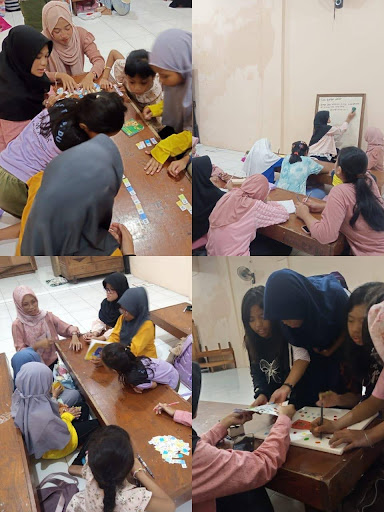
Surabaya – A learning assistance program was once again carried out by PGPAUD UNESA students at Sanggar Merah Merdeka, located at Lebak Arum No. 21, Surabaya. The program took place on Wednesday, April 29th, 2026, from 6:00 PM to 8:00 PM, involving elementary school children divided into two groups: Tunas Class (Grades 1–2) and Melati Class (Grades 3–4). This activity not only focused on improving academic abilities but also concluded with a creative activity as a keepsake for the learning center.
The activity was conducted by four university students, namely Ais, Nanda, Rara, and Shilfi, who served as facilitators in assisting the children’s learning process. Through interactive and enjoyable approaches, the university students aimed to create an active and conducive learning atmosphere while also increasing the children’s motivation to learn.
At 6:00 PM, the activities began in Tunas Class, consisting of students from Grades 1 to 2 elementary school. In this session, the university students monitored and guided the children in memorizing multiplication tables from 1 to 10. The children appeared to sit in groups while repeating their memorization together. Afterward, each student was individually asked to recite their memorization to the facilitators.
This method was implemented to train memory skills while also increasing the children’s self-confidence. Nanda and Rara actively assisted students who still experienced difficulties, while Ais and Shilfi also helped ensure that every child received sufficient attention. The classroom atmosphere appeared lively through the interactions between the university students and the children, all supporting the learning process together.
After the memorization session was completed, the activities continued with the introduction of a multiplication domino game. This learning media was used as an enjoyable educational tool so the children could more easily understand multiplication concepts. Through the game, the children were invited to match multiplication results with the appropriate numbers on the domino cards.
The children’s enthusiasm visibly increased when the game began. They looked excited while matching the cards and discussing answers with their friends. This approach proved effective in making the learning process more interesting and less monotonous. Some children even began creating their own game rules, which added more excitement to the learning atmosphere.
At around 7:00 PM, the activities continued in Melati Class, consisting of students from Grades 3 to 4 elementary school. In this session, the university students once again began with multiplication and division memorization as reinforcement of the basic concepts previously learned. The children took turns reciting their memorization to the facilitators.
Afterward, the lesson continued with learning formulas for plane geometry, such as calculating the area and perimeter of squares, rectangles, and triangles. Shilfi and Ais explained the material in a simple manner accompanied by example problems so the children could understand the concepts more easily. The explanation was supported with simple visual media such as drawings and a whiteboard, helping the children better visualize the concepts being taught.
As practice, the university students then provided several problems for the children to solve. The children worked on the exercises with guidance from the facilitators. During the process, collaboration among students could clearly be seen as they discussed together to find the correct answers. This interaction demonstrated that learning occurred not only between teacher and student but also among the students themselves.
The university students also provided positive reinforcement through praise and encouragement for children who dared to try and answer questions, even when mistakes were still made. This approach aimed to foster self-confidence and courage in learning. Such positive methods were considered effective in creating a safe and enjoyable learning environment for children.
Toward the end of the activities, the university students invited all participants to join a creative closing activity, namely finger painting using acrylic paint. Every child, facilitator, and university student was asked to dip their thumb into paint and place their thumbprint onto a prepared canvas.
This activity aimed to provide a keepsake for Sanggar Merah Merdeka as a form of gratitude for the opportunity given to the university students to conduct community service activities. The colorful thumbprint artwork became a symbol of togetherness and collaboration among the university students, children, and the learning center. In addition, the activity also trained the children’s creativity and artistic expression freely.
Besides the main activities, the university students also included a short reflection session with the children. During this session, the children were invited to express their feelings after participating in the learning activities. Some children stated that they felt happy because learning became more enjoyable, while others admitted that they better understood multiplication and geometry concepts.
The university students also provided learning media they had created for future use at the learning center. These media included multiplication cards, educational games, and worksheets designed according to children’s developmental stages. It is hoped that these materials will continue supporting the children’s learning process even after the mentoring program has ended.
As a closing session, the activity ended with a group photo involving the learning center administrators, facilitators, children, and PGPAUD UNESA students. This moment became both documentation and a beautiful memory of the togetherness built throughout the activities.
Overall, the learning assistance program ran smoothly and provided positive impacts on the children. They not only gained better understanding of mathematics material but also experienced enjoyable and interactive learning activities.
For the university students, the activity became an opportunity to develop teaching skills, communication abilities, and creativity in designing innovative learning media. Direct interaction with children provided valuable real-life experiences in education, especially in understanding the characteristics and learning needs of early childhood and elementary school students.
Furthermore, this activity also reflected the role of university students as agents of change capable of making meaningful contributions to society. Through simple programs such as learning assistance, university students can help improve educational quality within the community, especially for children who need additional support outside formal schools.
Through this activity, Sanggar Merah Merdeka once again demonstrated its role as an alternative learning space supporting children’s academic and creative development. The presence of the learning center is very important as a place where children can learn, play, and develop optimally.
It is hoped that similar programs can continue to be implemented in the future with broader coverage and more varied activities. Through collaboration between university students and the learning center, learning activities outside school can become more meaningful and enjoyable while also shaping a generation that is more confident, creative, and prepared to face future challenges.
This activity proves that learning does not always have to take place in formal classrooms. With the right approach, an enjoyable learning atmosphere, and support from various parties, the educational process can happen anywhere and anytime. This also emphasizes the importance of collaboration between higher education institutions and the community in creating inclusive and sustainable learning environments.
